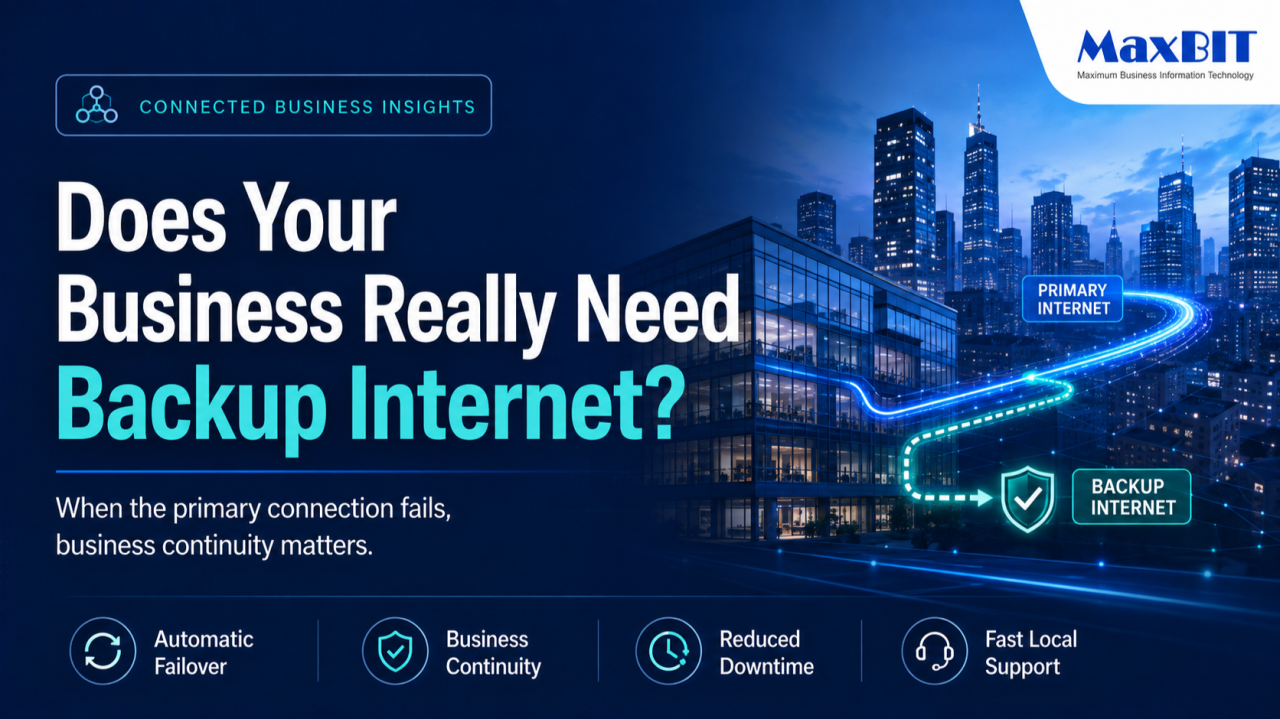
Does Your Business Really Need Backup Internet?
Imagine this.
It is 10:00 AM on a busy working day.
Your team is using cloud applications. Sales is updating the CRM. Finance is processing transactions. Customer service is answering calls. Management is in an online meeting.
Then suddenly:
The Internet goes down.
What happens next?
Can your team continue working?
Can customers still reach you?
Can your systems continue processing transactions?
Or does part of your business simply stop?
This is why I believe the question is no longer:
“Do we have Internet?”
The better question is:
“What happens to our business when the Internet fails?”
For many companies today, Backup Internet is no longer just an IT upgrade.
It is becoming part of business continuity.
One Internet Connection Means One Point of Failure
Article content
Most businesses have a primary Internet connection.
When it works, everything feels normal.
The problem becomes visible only when that connection fails.
A fiber cut.
Network equipment failure.
Power problem.
Infrastructure issue.
Construction damage.
Unexpected technical incident.
Any of these can interrupt connectivity.
And even a very reliable Internet Service Provider cannot guarantee that physical infrastructure will never experience a problem.
That is why businesses should think beyond:
“How reliable is my Internet provider?”
and also ask:
“What is my backup plan if something goes wrong?”
A reliable primary connection is important.
A well-designed backup connection adds another layer of protection.
What Does Internet Downtime Actually Affect?
The impact depends on the type of business.
But today, many daily operations depend directly on connectivity.
When the Internet stops, businesses may lose access to:
CRM systems
Cloud applications
VoIP and call center systems
Online payments
Video meetings
Email
File sharing
ERP systems
Remote access
Customer service platforms
Security monitoring
Communication between branches
So Internet downtime is not simply an “IT problem.”
It can quickly become a:
Productivity problem.
Customer experience problem.
Revenue problem.
Management problem.
And eventually, a business problem.
A Simple Question Every Business Leader Should Ask
Try this exercise:
If your Internet stopped for one hour tomorrow, what would happen?
Would employees continue working normally?
Would customers experience delays?
Would your sales team still access the CRM?
Would your call center continue operating?
Would online transactions continue?
Would management still access critical systems?
Would another connection automatically take over?
If the answer to several of these questions is no, then Backup Internet deserves serious consideration.
Does Every Business Need Backup Internet?
Not necessarily.
This is important.
I do not believe every company should buy technology simply because someone tells them it is “essential.”
The right solution should depend on the actual business requirement.
A very small office with limited online operations may tolerate temporary downtime.
But Backup Internet becomes increasingly important when a company depends heavily on digital operations.
Businesses that should seriously consider Backup Internet include:
1. Companies using cloud systems
If CRM, ERP, accounting, file storage, collaboration, or other critical applications are cloud-based, Internet connectivity becomes essential.
2. Call centers and customer service operations
If your telephone or customer support system relies on VoIP or cloud platforms, an Internet outage can immediately affect customers.
3. Hotels and hospitality businesses
Guest Wi-Fi, booking systems, payments, internal systems, and customer experience can all depend on connectivity.
4. Financial and payment-related businesses
Connectivity interruptions can affect transactions, systems, communication, and service availability.
5. Factories and logistics companies
Modern operations may depend on cloud systems, monitoring, warehouse systems, communications, and connections between locations.
6. Companies with multiple branches
Branches often depend on centralized systems, cloud applications, VPNs, or communication with headquarters.
7. Businesses where downtime directly costs money
This is perhaps the simplest test.
If losing Internet means losing customers, productivity, transactions, or revenue, then the value of Backup Internet becomes much easier to understand.
Backup Internet Is Not Just “Buying Another Line”
This is where planning matters.
Having two Internet connections does not automatically mean you have true redundancy.
Imagine having two fiber connections, but both cables travel through the same physical route.
If construction damages that route, both connections could fail at the same time.
That is not much of a backup.
It is two bills sharing one problem.
A proper Backup Internet strategy should consider:
Different network routes
Different infrastructure where possible
Automatic failover
Router configuration
Required backup bandwidth
Critical applications
Recovery time
Network monitoring
Technical support
The design should reflect how important connectivity is to the business.
How Automatic Failover Works
See content credentials
Article content
A good business network can be designed so that the backup connection takes over when the primary Internet connection fails.
The idea is simple:
Primary Internet ↓ Normal business operations
If the primary connection fails:
Primary Internet Failure ↓ Automatic Failover ↓ Backup Internet ↓ Business Continues Operating
When the primary connection becomes stable again, the network can return to its normal configuration.
For users, the objective is to make the interruption as small as possible.
That is the real value of redundancy.
Not having two Internet connections.
But having a business continuity plan for connectivity.
How Much Backup Bandwidth Do You Need?
Another common question is:
“Should my backup connection have the same speed as my primary Internet?”
Not always.
The answer depends on the business.
Some companies need full redundancy because almost every application is critical.
Others may only need enough backup bandwidth to support essential operations.
For example, during an outage, a company may prioritize:
CRM
Email
VoIP
Customer support
Online transactions
Management systems
while temporarily reducing bandwidth for non-critical activities.
This can make the Backup Internet solution more cost-effective while still protecting the business.
The objective should not simply be:
“Buy more bandwidth.”
It should be:
“Identify what must continue operating when something goes wrong.”
Reliability Is About Preparation
There is an important lesson here.
Business continuity is not about believing nothing will ever fail.
It is about preparing for failure so that the impact is controlled.
The same principle applies to:
Power → generator or UPS
Data → backup and recovery
Servers → redundancy
Cybersecurity → incident response
Internet → backup connectivity
Good technology planning assumes that problems can happen.
Then it asks:
“How quickly can the business recover?”
My Approach to Business Connectivity
When discussing Business Internet with customers, I prefer to start by understanding the business rather than immediately recommending a package.
Some of the questions I consider are:
How many people use the network?
Which applications are critical?
Does the company use cloud systems?
How much would one hour of downtime affect operations?
Does the business use VoIP or a call center?
Are there multiple locations?
What Internet connection already exists?
Is there currently a backup connection?
How is the internal network designed?
Only after understanding these factors does it make sense to discuss the right connectivity solution.
At MaxBIT, this is why we believe a site survey and network assessment are important before recommending Business Internet, Dedicated Internet, or Backup Internet.
The goal should be to create the right solution for the business, not simply sell the biggest package.
So, Does Your Business Really Need Backup Internet?
Here is the simplest way I would answer that question:
If your business can continue normally without Internet for several hours, Backup Internet may not be a high priority.
But...
If losing Internet means losing productivity, customers, transactions, communication, or revenue, then Backup Internet should probably be part of your business continuity strategy.
Because the question is not whether an Internet outage will ever happen.
The important question is:
When it happens, is your business ready?
I would like to hear your experience.
If your company's Internet went down for one hour tomorrow, which part of your business would be affected first?
CRM?
Customer service?
Payments?
Operations?
Cloud applications?
Something else?
Share your answer in the comments. I would be interested to learn how different businesses manage connectivity risk.
And if you find these practical discussions around Business Internet, technology, connectivity, AI, and digital transformation useful, subscribe to Connected Business Insights.
I publish practical insights for business leaders who want technology to improve reliability, efficiency, customer experience, and business growth.
#BusinessInternet #BackupInternet #BusinessConnectivity #NetworkReliability #BusinessContinuity #ReliableBusinessInternet #DedicatedInternet #MaxBITISP