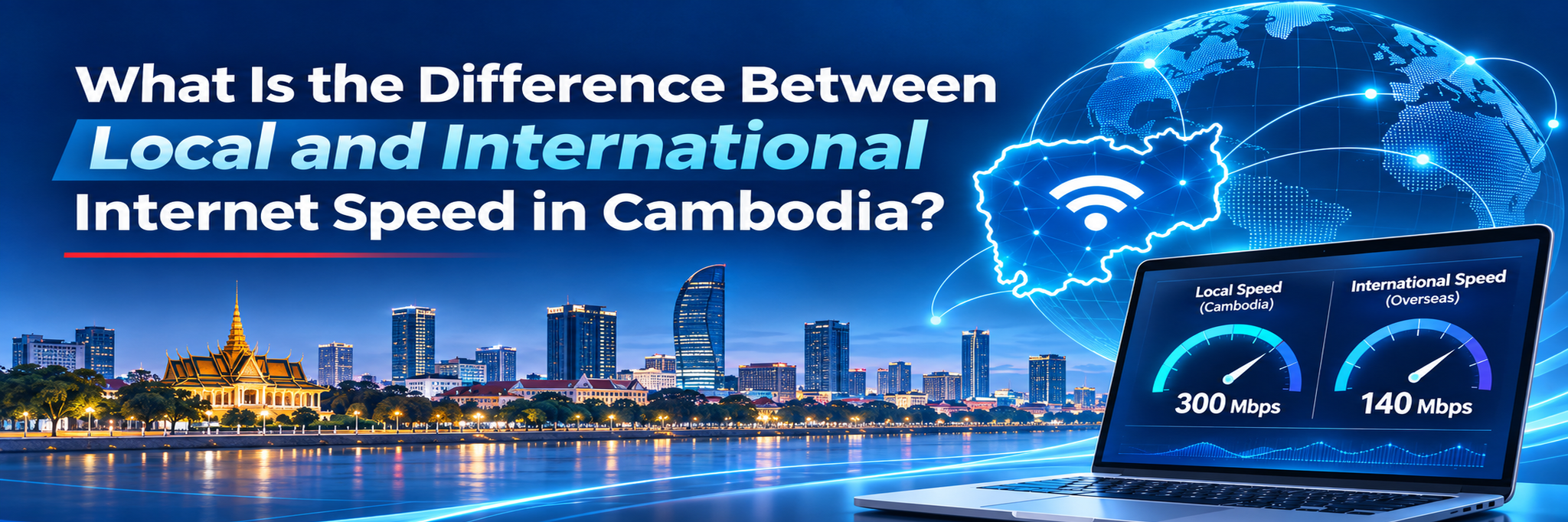
What Is the Difference Between Local and International Internet Speed in Cambodia?
Have you ever tested your internet connection in Cambodia and received an impressive result of 200 Mbps, 300 Mbps, or even 500 Mbps, only to discover that overseas websites are loading slowly?
Perhaps your internet connection works perfectly when accessing local services, but you experience delays during international video meetings, cloud file transfers, or when accessing overseas business applications.
This happens because local internet speed and international internet speed are not necessarily the same.
Understanding this difference can help individuals and businesses in Cambodia identify connectivity problems, better understand internet packages, and make informed decisions when choosing an Internet Service Provider (ISP).
What Is the Difference Between Local and International Internet Speed?
Local internet speed refers to the performance of data transmission between your internet connection and servers located within Cambodia. International internet speed refers to the performance of data transmission between your connection and servers located outside Cambodia.
When you access a server hosted in Phnom Penh, your data may travel entirely through domestic network infrastructure. However, when you access a server in Singapore, Hong Kong, Japan, Europe, or the United States, your data must travel through international network infrastructure and potentially several interconnected networks.
These connections can have different bandwidth capacities, latency levels, and network conditions, resulting in different internet performance even when using the same internet package.
It is also important to understand that a website with a Cambodian domain name is not necessarily hosted in Cambodia. Similarly, an international website may deliver its content through a local or regional server using a Content Delivery Network (CDN).
The actual server location and network route determine how your internet traffic travels.
Why Is Local Internet Often Faster Than International Internet?
Local internet often performs better because data generally travels through shorter network routes, resulting in lower latency and potentially fewer network bottlenecks.
Imagine sending a document from your office in Phnom Penh to another office within the same city. Compare this with sending the same document to an office in the United States. The international journey involves a greater distance and potentially more transportation networks.
Internet connectivity works in a similar way.
When accessing international websites, data may travel through cross-border fiber connections, submarine cable systems, international transit providers, and multiple network operators before reaching its destination.
Cambodia connects to the global internet through international telecommunications infrastructure, including terrestrial fiber connections with neighboring countries and submarine cable connectivity.
Physical distance, international bandwidth capacity, network congestion, and routing efficiency can all influence internet performance.
Another important factor is how Internet Service Providers exchange traffic with other networks. Through peering arrangements and international transit providers, ISPs establish routes that allow customers to access online services worldwide.
Efficient international routing can reduce unnecessary network delays, while inefficient or congested routes can negatively affect internet performance.
However, local internet is not always faster in terms of download and upload speed. A well-connected international server may perform better than a congested local server.
This is why internet performance depends not only on geographical distance but also on the capacity, quality, and stability of the networks involved.
Why Is My Cambodian Speed Test Fast but Overseas Websites Slow?
A fast local speed test does not necessarily mean that your international internet connection is equally fast.
Many popular internet speed testing platforms automatically select a nearby test server. If you are located in Phnom Penh, the platform may select a server within Cambodia.
For example, imagine a business in Phnom Penh that subscribes to a 300 Mbps internet package. When testing against a local Cambodian server, the company achieves nearly 300 Mbps with a latency of 4 milliseconds.
However, when testing against a server in Singapore, the result might decrease to 140 Mbps with a latency of 35 milliseconds. A test against a server in the United States might produce a result of 45 Mbps with a latency of 210 milliseconds.
These figures are illustrative examples, not actual MaxBIT performance measurements or guaranteed internet speeds.
The difference occurs because each speed test measures performance across a different network path.
A Cambodian speed test demonstrates how well your connection performs when communicating with that particular local server. It does not necessarily represent the performance of your internet connection to international destinations.
Overseas websites may also load slowly because of international network congestion, inefficient routing, remote server limitations, DNS delays, VPN restrictions, firewall configurations, or problems within your own office network.
Therefore, slow access to international websites does not automatically mean that your ISP is providing poor service or restricting your internet connection. Further testing is necessary to identify the actual cause.
For businesses that depend on international applications, testing only a local Cambodian server provides an incomplete picture of internet performance.
What Does Global Bandwidth Mean in Cambodia?
Global bandwidth, also commonly referred to as international bandwidth or global internet speed, generally describes the network capacity available for transmitting data between your internet connection and international destinations.
In Cambodia, some Internet Service Providers offer internet packages with different advertised speeds for local and international connectivity.
For example, an internet package may advertise a headline bandwidth of 300 Mbps and a global bandwidth of 80 Mbps.
Under such a package structure, customers may have access to higher speeds when communicating with eligible local networks, while international traffic is subject to a separate advertised bandwidth limit or allowance.
However, an advertised global bandwidth of 80 Mbps does not guarantee that every international website or server will deliver 80 Mbps. Actual performance depends on network routing, congestion, destination server capacity, and the service conditions agreed with the ISP.
It is also important to understand whether international bandwidth is shared among multiple customers or provided as committed capacity under a service agreement.
Shared bandwidth performance may fluctuate depending on network usage, while committed bandwidth provides a defined level of capacity within the scope of the service agreement.
Different Internet Service Providers may define global bandwidth differently. Customers should confirm whether the advertised bandwidth applies to local traffic, international traffic, or both, and whether the specified capacity applies to download and upload traffic.
Understanding global bandwidth is particularly important for businesses that rely on international cloud services, overseas servers, video conferencing, and global communications.
Why Is International Internet Performance Important for Businesses in Cambodia?
Modern businesses increasingly depend on digital applications and infrastructure that may be hosted outside Cambodia.
A company may store its documents in Microsoft 365 or Google Workspace, manage customer information through a cloud-based CRM, communicate with international partners through Zoom or Microsoft Teams, or access an ERP system hosted in another country.
A manufacturing company in Cambodia may need to transfer production data to its overseas headquarters. A call center may require stable connections to international voice platforms, while a logistics company may depend on cloud-based shipment tracking and inventory management systems.
In these situations, international internet performance can directly affect employee productivity, communication quality, customer service, and daily business operations.
A business with high local internet speed but inconsistent international connectivity may still experience interrupted video meetings, slow file transfers, delayed application responses, and difficulties accessing overseas systems.
For organizations operating multiple branches or communicating regularly with international partners, stable international connectivity can be particularly important.
This is why businesses should evaluate internet quality based on their actual operational requirements rather than simply choosing the package with the highest advertised speed.
Is Internet Speed the Only Factor That Affects International Connectivity?
No. Bandwidth is only one component of overall internet performance. Latency, jitter, packet loss, and network stability are also important factors.
Bandwidth determines how much data a connection can carry per second, typically measured in megabits per second (Mbps). Higher bandwidth allows more data to be transferred and can support more simultaneous users and applications.
Latency measures the time required for data to travel across a network. Internet speed tests commonly report round-trip latency in milliseconds (ms).
A connection can have high bandwidth but still experience high latency. For example, a business may have a high-speed internet connection to a server in the United States, but employees may still notice delays when interacting with applications hosted on that server because of the longer network distance.
Jitter describes the variation in latency over time. High jitter can cause poor audio quality, interrupted video meetings, and inconsistent real-time communication.
Packet loss occurs when some data packets fail to reach their intended destination. Even with sufficient bandwidth, packet loss can cause application delays, interrupted communications, and reduced network performance.
For businesses, a quality internet connection requires an appropriate combination of sufficient bandwidth, suitable latency, low jitter, minimal packet loss, and consistent network performance.
Higher internet bandwidth alone does not necessarily solve every connectivity problem.
How Can Businesses Test International Internet Performance in Cambodia?
The most effective way to evaluate international internet performance is to test connections to multiple overseas destinations and compare the results with local internet performance.
Businesses can begin by using an online testing platform such as Speedtest by Ookla.
Start by performing a speed test using a Cambodian server, preferably in Phnom Penh or another suitable domestic location. Record the download speed, upload speed, and latency. This establishes a reference for local internet performance.
Next, manually select an international test server in a country relevant to your business operations. Singapore and Hong Kong are useful regional testing destinations for many Cambodian businesses, while Japan, Europe, and the United States may be relevant depending on where your business applications and servers are hosted.
Testing more than one server in each region can help reduce the possibility that an overloaded test server produces misleading results.
For more accurate measurements, conduct your tests using a wired Ethernet connection rather than Wi-Fi whenever possible. Wireless interference, router limitations, background downloads, and other connected devices can affect speed test results.
It is also advisable to repeat the tests during different periods of the day. A connection that performs well in the morning may experience congestion during peak usage hours.
Businesses should record and compare download speed, upload speed, latency, jitter, and packet loss rather than focusing exclusively on the download speed displayed by the testing platform.
Most importantly, businesses should evaluate the actual applications they use every day. If your ERP system is hosted in Singapore, the performance of that specific system is more relevant than a speed test to an unrelated server in another country.
For persistent connectivity problems, professional network diagnostic tools such as traceroute and MTR can help technical teams investigate network routes, latency, packet loss, and potential connectivity issues. These diagnostic results should be interpreted carefully because some network devices may deprioritize diagnostic traffic.
Combining speed tests with professional network diagnostics provides a more comprehensive understanding of international internet performance.
Will Upgrading My Internet Package Improve International Internet Speed?
Not necessarily. Upgrading an internet package may improve international internet performance if insufficient bandwidth is the primary cause of the problem.
However, if the issue is related to international routing, network congestion, high latency, packet loss, firewall configurations, or the destination server, purchasing additional bandwidth may not resolve it.
For example, upgrading from 100 Mbps to 300 Mbps may allow more employees to access online services simultaneously. However, it may not significantly reduce the latency between Phnom Penh and a server located in the United States.
Similarly, upgrading local bandwidth may not improve international internet speed if the new package maintains the same international bandwidth allowance.
Before upgrading an internet package, businesses should identify the actual cause of their connectivity problems.
A professional network assessment can help determine whether the appropriate solution involves additional bandwidth, increased international capacity, better network routing, dedicated internet access, or improvements to the internal office network.
Is Dedicated Internet Better for International Connectivity?
Dedicated Internet Access (DIA) can be a suitable option for businesses that require more consistent connectivity, committed access bandwidth, and clearly defined service commitments.
Unlike typical best-effort broadband services, dedicated internet services may provide committed bandwidth under specific contractual conditions.
This can be particularly valuable for businesses that depend on international cloud applications, overseas communications, remote servers, and other business-critical online services.
However, dedicated internet does not automatically guarantee the same speed to every international destination. International performance remains dependent on upstream network capacity, routing efficiency, destination server conditions, and the applicable Service Level Agreement (SLA).
Businesses considering dedicated internet should discuss their international bandwidth requirements, critical applications, upload requirements, and performance expectations with their ISP.
The objective is not simply to purchase a more expensive internet package but to establish a connectivity solution that supports the organization's actual business operations.
What Should Businesses Consider When Choosing an Internet Service Provider in Cambodia?
When choosing an Internet Service Provider in Cambodia, businesses should look beyond advertised internet speeds and monthly subscription prices.
Understanding how an ISP defines local and international bandwidth is an important starting point. Businesses should also consider network stability, international routing, upload performance, technical support, and the service-level commitments available under their chosen package.
An organization that primarily uses locally hosted applications may have different connectivity requirements from a company that communicates with overseas headquarters or operates entirely through international cloud platforms.
Businesses should discuss their actual connectivity requirements with the ISP's technical team before selecting an internet package.
Understanding the number of connected users, frequently accessed international destinations, business-critical applications, and daily network usage can help determine the appropriate internet capacity.
The most suitable internet service is one that supports the company's operational requirements consistently, including during periods of high network demand.
How Can Businesses Identify the Cause of Slow International Internet?
Identifying the cause of slow international internet requires more than performing a single speed test.
If both local and international speed tests show poor results, the problem may be related to the internet access connection, router, Wi-Fi network, internal network congestion, or insufficient bandwidth.
If local internet performance is good but multiple international destinations consistently perform poorly, international bandwidth capacity, network congestion, or overseas routing may require further investigation.
If only one particular international website or application is slow while other overseas services perform normally, the problem may be related to that specific destination server, application, or network route.
Professional technical assessment can help businesses distinguish between these different situations and avoid unnecessary spending on internet upgrades that may not resolve the underlying problem.
Conclusion: A Fast Local Speed Test Does Not Tell the Whole Story
Local and international internet speeds measure connectivity across different network paths. A high local speed test result does not necessarily guarantee equally high performance when accessing international websites or overseas business applications.
For businesses in Cambodia, understanding global bandwidth, international routing, latency, packet loss, and network stability is essential when evaluating internet quality.
Rather than choosing an internet package based solely on advertised Mbps, businesses should assess how their connection performs when accessing the applications and international destinations that support their daily operations.
A quality business internet connection is not simply about achieving the highest speed test result. It is about delivering reliable, consistent, and suitable connectivity for real business requirements.
Need Help Understanding Your Business Internet Performance?
If your business is experiencing slow international internet speeds, unstable connectivity, or difficulties accessing overseas applications, MaxBIT's technical team can help assess your network, understand potential connectivity issues, and recommend suitable solutions based on your actual business requirements.
Whether you are planning a new office network, reviewing your existing internet service, or experiencing international connectivity problems, a professional technical assessment can help you make a more informed decision.
Contact MaxBIT's technical team today for a free technical site survey.
Request Your Free Technical Site Survey
MaxBIT — Business Internet & Enterprise Connectivity Solutions in Cambodia